kaasirpent: (WriteWright)
Wednesday, October 17th, 2012 08:15 pm

Note: I don’t make it a habit to rant, here, but I felt the need to vent about this.

This is something I wasn’t aware of until some friends of mine pointed it out last night. A writer of their acquaintance whom I shall call "Jack" sent out an email to the Atlanta Writers Club with the following title:

Jack Writer Has a New Pulitzer Nominated Book

Jack is published through what I will call a small press, but an argument could be made for calling it a vanity press. I’ve met the owner of this publishing house, and although he seems like a nice, earnest person, there was something about his answers to basic business-of-writing questions that told us he’s not really all that knowledgeable about things like contracts and rights. Which a publisher should be, if he expects to stay in business long.

The email provided a link to the book’s PR site (part of the service provided by his publisher). The page contains a number of blurbs (a.k.a. "puffs") written in that breathless style seemingly reserved for such purposes. "An instant classic!" "A tour-de-force!" "I wasn’t able to put it down!" "Jack’s story grabs you by the throat and won’t let go until the final page!" Etc. You know the type. The purpose of a blurb or puff is to influence you to buy the book. Authors (or their publishers) generally get well-known authors in their genre to provide quotes. According to Marilyn Henderson on AbsoluteWrite,

When an author gives another writer a blurb, it implies an endorsement or recommendation of the novel. Her fans may buy your book on the strength of her liking it enough to let her name be on it. It also implies her fans will like your book, so you must choose the author you ask carefully.

If her stories do not include on-stage murder, violence or profanity, for example, her fans don’t expect any in a book she recommends. They assume a novel she "endorses" will be similar to hers. If it isn’t, her publisher may get angry letters, and she may lose fans and sales.

Just as you must know the audience you write for, you must know the audience of the authors you ask for blurbs.

Recognizing none of these authors’ names, I looked a few of them up and discovered that they, too, are either self-published authors or published by small, niche-market publishers. One of them was billed as a critic for a prominent online newspaper which I will decline to mention. I looked him up, and sure enough, he’s a critic. A film and TV critic. Who publishes his reviews on his own site. And then this newspaper links to them.1 He has several books . . . also published by a small, niche publisher.

My point is that these book blurbs were all written by people in the same basic position as Jack: an author whose small publisher is probably pushing them to scratch a back in the interest of reciprocity. I have no proof of this; I’m supposing.

Now, let me be absolutely, crystal clear: none of that is an issue. I don’t have a problem with self publishing. I don’t have a problem with small publishers. I don’t have a problem with niche markets. I don’t have a problem with people getting their work in front of people by any reasonable means necessary. Except for one thing.

Pulitzer Nominated.

Surely that can’t be right. Can it? The Pulitzer is a major award. It seems unlikely that a book by an unknown writer would be nominated for such a prestigious honor.

So my friends looked into this a bit.

Turns out, anyone can enter the Pulitzer Prize competition. You pay $50 and send off a few copies and it’s "submitted." Officially entered in the contest for the Pulitzer. Notice that "submitted" is not the same as "nominated." That is a very fine distinction.

Read more here (Huffington Post article by Steve Lehto). A salient quote from that article:

The Pulitzer Prize organization has juries which select finalists in various categories and then the Pulitzer Prize Board picks the winners from those finalists. According to their own website, the only people who should say they are "nominated" for a Pulitzer Prize are the finalists who have been selected by the juries for consideration by the Pulitzer Prize Board.

Jack himself may not have had any say in this. The publisher may very well have paid the $50 and be urging him to hype the "Pulitzer Nominated" nonsense. And having met him, I can’t say that I would put it past him. That very earnestness I noted above may blind him to the negative impact something like this could have on both Jack’s and his own reputation.

So the morals of this story are these:

  1. Do not ever do this. It is at best a cheap marketing ploy. It is at worst a bold-faced lie. And if you’re caught at it by your peers, you’re going to have a hard time regaining whatever trust this costs you.
  2. If you hear of an author claiming his book is "Pulitzer Nominated," check the Pulitzer site before you believe it.

  1. My problem is the implied lie. Or lie of omission, if you will. Saying he is a "critic" "for" the ElectroNews Times (or whatever) implies that he is a full-time book / literature critic working directly on the payroll, not that he is a film / TV critic on his blog, which the publication then features. It’s the difference in saying, "Here comes the president" vs. "Here comes the president of the PTA." Both are true, but one is more truthful.

Originally published at WriteWright. You can comment here or there.

kaasirpent: (WriteWright)
Tuesday, October 16th, 2012 01:48 am
NaNoWriMo

NaNoWriMo

These are some thoughts I had on NaNoWriMo. They were originally written as part of a lengthy reply to a friend of a friend who was curious about the whole process of NaNoWriMo and who had some concerns about writing a character based on a real person.

It’s quite normal to agonize. Over your characters, your setting, your plot, your vocabulary, your grammar, whether semicolons are pure evil or useful, whether or not subtext exists, your skill as a writer, whether you should defrost the freezer before writing, how to clean the grout in your shower . . . procrastination takes on a whole level of evil when you have a deadline, or at least mine does. (Look up ‘waxing the cat.’ No, it’s not dirty.)

Writing something semi-biographical is rougher still, because of discomfort in potentially harming the person’s reputation or angering their descendants. Our society is litigious to a fault, after all. But it’s merely based on a real person. You may not want to take too many liberties, but you may not have ever met the person you’re basing the character on, especially if they lived and died before you were born. Just keep their best interests in mind (assuming you like them) and remember that no one is or ever has been a paragon of virtue. Everyone has a darkness. Everyone has flaws. If you don’t portray that, the character will come across as unbelievable. Flat. A caricature.

A lot of my very fictional characters have inside them a tiny core of someone — or a mixture of several someones — that I know. But I don’t worry about them figuring it out, because if I’ve done my job well enough, they’ll never know, even if they read it. But basing it on a real person, that might be harder to conceal, if you even want to conceal it. Let’s say it’s Frida Kahlo you’re writing about. Of course, people will know it’s her, and they’ll also know that you had to concoct stuff. But as long as you’re more or less faithful to the events and things people do know, and that’s consistent with the stuff you make up, then . . . sure, it might tick off some people, but others will read it and think, “You know, she could have thought that.”

My take on it is this: Write the story, and do the absolute best you can. NaNoWriMo is about getting the story out of your head and onto paper / electrons. It’s not about making it perfect. It will never be perfect. Rewrites are for getting it as close as you can. If what you have after November is over still strikes you as having something you like in it, you can go through it after letting it sit for a month or two without looking at it (that is key), and decide what works and what doesn’t. And if nothing works? You still learned what doesn’t work, and you probably have a better idea what will.

I have this Epic Fantasy story that has been knocking on the inside of my skull since I was around eleven. In different forms over the years, of course, but basically the same story. I must have written chapter one a hundred times. In pencil or pen. In a spiral-bound notebook. Because it had to be perfect or I wasn’t doing the story in my head any justice. So I’d write chapter one . . . and it would suck. And I’d hate it, and I’d rip the pages out and burn them. And then some time later, I’d write it again . . . and it would be slightly less sucky (at least to me), but not good enough. It wasn’t perfect. It. Had. To. Be. Perfect.

This went on for more than thirty years. Then in 2008, I finally decided, “Idiot, you’ve got to get this out of your head. Just write it.” So I took all my character notes and all my plot notes and all my other stuff and I started writing on November 1, 2008.

And by the end of that November, I had 53,515 new words that I never had before. And I got a lot of that out of my head. But I used virtually none of the copious notes I had been taking for all that time. I came up with some great new ideas. I invented new characters, thought of scenes I never realized were there, before, discovered things about my characters I never had. Because I learned something crucial:

To write the story, you have to bind and gag the editor that lives inside your head. And lock him in a small, dark room.

That editor will tell you that what you’re writing sucks. He’ll want you to go back and “fix” stuff. He’ll pester you to stop using the word ‘actually’ so much. So you have to beat him over the head with something hard, tie him up, stuff a gag in his mouth, and dump him in the basement and lock the door. Until you’re done.

You’ll find yourself around day eight or so thinking, “Gah! This blows. I’m just going to rewrite that last chapter because–” No! That’s your editor. Why didn’t you make those knots tighter? He got out! You have to club him again and make sure to tie him up tighter next time!

You don’t fix that chapter. You make notes in the margin and go on as though you had fixed it and don’t worry about it. So what if for six chapters your main character is a monk in a monastery in Tibet, but starting in chapter seven, he’s a famous Las Vegas entertainer? You assume the story has taken place along your new path up to chapter seven, and you go on.

You probably won’t encounter anything that drastic. I think my “drastic” change was that in Chapter nine, I realized one of the secondary characters needed a skill I hadn’t given her earlier, so I just assumed she’d always had it, made notes to go back and fix it, and wrote forward.

Of those 53,515 words I wrote in 2008, probably less than half of them are useful words. But what is useful is what I learned about those characters. When I go back and revisit that story and add more plot, the characters, setting, etc. will be all the better for having had to work through stuff to make it make a bit of sense for the novel. On the other hand . . . that story is no longer knocking on my head. I’ve moved on to other ideas. Better ideas. But I learned a lot in writing that epic fantasy, and I will still come back to it at some point, and by golly it’ll be better. Because I’m a better writer, now, than I was in 2008.

For 2009 I wrote a mystery novel (55,000+ words) and had no idea who the killer was until about halfway through. Same thing. I had to silence my editor, who kept saying, “Gary, what the hell are you doing? Who is the killer? Don’t you even know?” *PWANG* with a shovel right in the face. Basement. Knots.

For 2010 I wrote a science fiction novel involving time travel. Got to 78,000 words on that one, then 93,000 by February. Finished it. It needs editing big-time, but this time, my inner editor went on vacation to Aruba while I was writing. He learned. It only takes one or two shovels to the face to make an editor learn his lesson. But there’s some good stuff in that novel. Stuff I really like. And some stuff I really hate.

And yeah, no one ever has to see it but you. The only time you have to show anything is when you paste the full text into the site on the last day so it can verify your word-count. It’s not saved by their site. The count is tallied and all anyone need know is that you either did or did not make it to 50,000.

Even if you don’t get to 50,000 words, you’re 9000 words or 15,000 words or 27,000 words closer to having a book than you were when you started. Or 250 words. Any honest attempt is better than nothing.

If you’re worried about lawsuits resulting from basing a character on a real, historical figure . . . I’ll tell you what someone told me when I had some similar worries: When the publisher agrees to publish the novel, that’s when you worry about lawyers. Before then, tell the story and don’t worry about stuff like that. That’s not your job. You’re the writer. That worry is your editor talking. Remember what we do with internal editors? *grins evilly and hands you a shovel*

7 Tips on NaNoWriMo: Backup often. Backup often. Backup often. Backup often. Backup often. Backup often. Oh, and backups? Do them often.

Do you feel pepped? Has my pep talk helped? I love NaNoWriMo. Love. It. It pushes me to do things I’ve never done before, and with each November, I feel more pumped up than the last one.

Originally published at WriteWright. You can comment here or there.

kaasirpent: (WriteWright)
Friday, June 15th, 2012 06:42 pm

For almost as long as I’ve been writing, I’ve heard a nearly1 consistent piece of writing advice: Avoid the tired cliché of having the character look into a mirror so you, the writer, have an excuse to describe the character to the reader.

It just isn’t to be done.

Unless, of course . . . you happen to know how to do it right. I have just read a passage that impressed me as a way to do it right. The following is an excerpt from the novel We by Yevgeny Zamyatin. I’m reading the Kindle version of the English translation (from Russian, if that’s not clear) by Clarence Brown. I quote this for review purposes and do not intend to infringe on anyone’s anything.

I’m in front of a mirror. And for the first time in my life, I swear it, for the very first time in my life, I get a clear, distinct, conscious look at myself; I see myself and I’m astonished, like I’m looking at some “him.” There I am—or rather, there he is: He’s got straight black eyebrows, drawn with a ruler, and between them, like a scar, is a vertical crease (I don’t know if it was there before). Gray, steel eyes, with the circle of a sleepless night around them; and behind that steel—it turns out I never knew what was there. And from that “there” (a “there” that is here and at the same time infinitely far away)—I am looking at myself, at him, and I am absolutely certain that he, with his ruler-straight eyebrows, is a stranger, somebody else, I just met him for the first time in my life. And I’m the real one. I AM NOT HIM.

Isn’t that wonderful? Of course, it’s immediately obvious that, aside from the eyebrows, eyes, and the dark circles around his eyes, he doesn’t actually describe himself. We have no idea if he’s blond or brunette or has a pimple on his nose or if his earlobes are attached or detached. But I think that’s the whole point. This looking-into-the-mirror scene isn’t about describing the character, but having the character discover something unnerving about himself. That we learn a few details of his appearance is basically a side-effect of the real purpose of the paragraph.

It’s one of my favorite passages from this book, so far, and there have already been quite a few. (I’m 32% done with it.)


  1. A couple of years ago, I took a writing workshop from a local (to Atlanta, GA) author. He actually—against all advice I’ve heard to the contrary—recommended the technique. I considered said advice with a large grain of salt, mind you, but hey. :)

Originally published at WriteWright. You can comment here or there.

Tags:
kaasirpent: (WriteWright)
Tuesday, April 24th, 2012 05:24 pm
Progress by dingatx, on Flickr
Creative Commons Attribution-Noncommercial 2.0 Generic License  by  dingatx 

It’s been about a month since I last updated my blog. I’ve had a busy social life and a sick cat and frankly haven’t written much. I also helped out a fellow writer by critiquing her entire finished novel over the last couple of weeks.

But another thing I did work on was submissions.

I finally bit the bullet and submitted a manuscript to Viable Paradise. In their own words,

Viable Paradise is a unique one-week residential workshop in writing and selling commercial science fiction and fantasy. The workshop is intimate, intense, and features extensive time spent with best-selling and award-winning authors and professional editors currently working in the field. VP concentrates on the art of writing fiction people want to read, and this concentration is reflected in post-workshop professional sales by our alumni.

Viable Paradise encourages an informal and supportive workshop atmosphere. During the week, instructors and students interact in one-on-one conferences, group critiques, and lectures. The emphasis at first is on critiquing the students’ submitted manuscripts; later, the emphasis shifts to new material produced during the week. Even when not actively engaged in teaching or critiquing, instructors often share meals and general conversation with the students.

The Viable Paradise experience is more than the workshop itself; it also includes the autumnal beauty of coastal New England and the unique island setting of Martha’s Vineyard. Taken all together, they create a learning environment that’s perfect for helping you reach your writing and publishing goals.

I’ve wanted to go to VP pretty much since the first day I heard about it—Egad! Six years ago!—when podcaster and writer extraordinaire Mur Lafferty went in 2006 (VPX) and talked about the experience.

Of course, I’d also like to go to Clarion/Clarion West. But I have a full-time job and only 23 PTO days per year, and Clarion takes six weeks, or 30 PTO days. (Which actually isn’t all that bad, considering. They’d only have to let me do a leave of absence for seven work days . . .)

The shortage of time off still didn’t stop me from attempting to apply. I mean, once I got in, I could worry about getting time off, right? But I misread the submission guidelines. I worked for hours editing a story to get it as perfect as I could get it. And then with just about twenty minutes to spare, I was getting ready to email everything in and . . . realized they had asked for two short stories, each between 2500 and 6000 words. I had just the one, and it was 6900 words.

Here’s a tip: Read the submission guidelines thoroughly, boys and girls. <grumbleblather>

Not that Viable Paradise was a distant second choice, mind you. It could even be argued that my subconscious sabotaged Clarion on purpose. Dastardly subconscious.

I sent in my submission on April 16th. The deadline is June 15th. They will make a decision as soon as possible after that date and let everyone know one way or the other. Only 24 students will be accepted. They will, of course, have to read and evaluate all the submissions they get at the last minute, so I wouldn’t expect to hear one way or the other before the 20th of June, certainly.

So now, I wait. Patiently? Well . . . :)

In other news, I have recently started listening to a newish podcast called Toasted Cake by Tina Connolly. Tina is an accomplished author (and Clarion West 2006 graduate) and voice artist who frequently voices stories for the three Escape Artists podcasts, EscapePod, PseudoPod, and PodCastle, as well as Drabblecast and Three-Lobed Burning Eye.

She decided to podcast a flash story per week for 2012. She hit up her writer friends for the first dozen or so, then opened up for submission from interested listeners during April. I sent her three of my extremely short flash pieces to see if they strike her fancy. She likes ‘em dark and kind of twisted, which these three are. I sent the anti-Valentine’s Day poem, “Pot O’ Gold,” and “Nothing Lasts Forever,” all of which I have put on this blog in the last year. I should get a “Pass” or “Hold” email before too long. Submission deadline is April 30, and I sent it in a couple of days ago.

So that’s basically what I’ve been up to. Which doesn’t amount to much on the page, but I’m hoping one or the other or both of those pan out.

What I have done, writing-wise, is come up with a veritable mother-load of ideas for the second novel in the Urban Fantasy series I’ve come up with (which I’m tentatively calling The PCIU Case Files). You know, the second novel. I haven’t finished the first one, but my brain is supplying me all kinds of good stuff for the second one.

Stupid brain.

Originally published at WriteWright. You can comment here or there.

kaasirpent: (WriteWright)
Tuesday, November 22nd, 2011 01:21 am


Tonight marks the close of the 7th day of NaNoWriMo 2011.

So, I have just completed week 3 of this craziness. I had every intention of doing a week 2 report, as well, but I just didn’t have time. You’ll see why in a moment. After day 7, I had 44,717 words, less than 6,000 words shy of “winning” NaNoWriMo. Here are my individual story word-counts as of midnight, November 22nd.

“A Is for Anchor” – 10,574 words – incomplete – Magic Realism
“B Is for Bard” – 10,092 words – incomplete – Fantasy
“C Is for Clowns that Creep Through the Yard” – 5719 words – complete – Horror

“D Is for Dragon” – 6,369 words – complete – Fairy Tale + Humor
“E Is for Egg” – 4,975 words – complete – Science Fiction
“F Is for Fangs that Are Sunk in Your Leg” – 9,039 words – incomplete – Science Fiction

“G Is for Gravesite” – 2,204 words – complete – Fantasy
“H Is for Haunted” – 5,309 words – incomplete – Horror
“I Is for Investigation: Unwanted” – 6,627 words – incomplete – Urban Fantasy

“J Is for Jackpot” – 3,069 words – complete – Dystopian Science Fiction
“K Is for Kiss” – 3,191 words – complete – Fairy Tale
“L Is for Lucky for a Hit or a Miss” – 3,219 words – complete – Dark Fantasy

“M Is for Moons” – 3,378 words – incomplete – Science Fiction + Fantasy
“N Is for Nocturnal” – 4,151 words – complete – Erotic Fantasy
“O Is for Oath of Service Eternal” – incomplete – Fantasy + Humor

“P Is for Prey” – 3,630 words – complete – Science Fiction
“Q Is for Quest” – 1,557 words – incomplete – Fairy Tale + Humor
“R Is for Ritual Performed as a Test” – 4,598 words – complete – Dark Fiction

“S Is for SkullCosm” – 3,872 words – incomplete – Science Fiction
“T Is for Talents” – 3,622 words – complete – Dystopian Science Fiction
“U Is for Unicorn Imbalance” – 1,826 words – complete – Dark Fantasy

If you add in the 617 words of “Fangs” that I wrote and then crossed out because I had chosen the wrong part of the story to start at and the 1527 words of “Nocturnal” that were an interesting science fiction idea that I could not make work before I changed it to Erotic Fantasy, that comes out to a grand total of 101,066 words as of today.

Here’s what the intervening two weeks of writing fast and furious to get to this many words has taught me.

  • Write through writer’s block. For the first seven stories (the first week), I had definite ideas (minus Anchor). When I sat down to write most of them, I knew the characters, plot, and world, and all I had to do was sit down and let the words out. It was actually fairly easy. I don’t think I have ever enjoyed writing so much as I did that first week. But then for Haunted, Investigation, Kiss, Moon, Prey, Quest, Ritual, and SkullCosm, I had only the vaguest notion of what the story was. At most I had a notion of character and a glimmer of a world. But I sat down at the keyboard and I just started typing, going with the first thing that popped into my head, inventing as I went along. As I went, I was forced to make decisions, and those decisions forced me to make others . . . and then before you know it, I had character, plot, and world. Do I love these stories? Not all of them. :) I think all of them are good ideas, and with a little work after NaNoWriMo, I may be able to pull a better story out of them, and you’ll notice that a lot of those are incomplete. But the important part is that I didn’t let not having a perfectly formed story stop me. I went with my original ideas and made them work, and I look forward to finishing the stories.
  • Butt in chair. For Jackpot, Lucky, Nocturnal, Oath, Talents, and Unicorn, I had less than no idea when I sat down to write at the beginning of the day. Not even the words for all but two of those. But I let my subconscious work on it, and each time, a story sparked. It’s interesting that of these most recent 14 stories, my favorite six are Jackpot, Lucky, Nocturnal, Oath, Talents, and Unicorn.
  • Trust your instincts. For Nocturnal, my first glimmer of an idea was involving Nyx, the Greek personification of the Night. I did a lot of research on her, but the story kept turning into erotic fiction, and I couldn’t figure out the POV. So I abandoned it and forced another interpretation, which I then tried to write. I got 1527 words in and said, “No. This isn’t working. This isn’t what I want to write.” So I scrapped it and started over using my original idea of Nyx, but told from the POV of a man she picks up from a bar. I’m not comfortable writing erotic fantasy, but apparently that’s what I needed to write, because that’s what came out. And other than the very last paragraph or two, I really like it.
  • Two—or sometimes 17—heads are better than one. I needed help on some of my ideas and I enlisted friends to help me out. I used names suggested by my Facebook friends in Dragon. The entire idea for Fangs came from a friend on LiveJournal. Kiss got its twist from yet another friend who made a typo to me in IM while trying to help me out. For Ritual, I used many suggestions from my friends on Facebook, although never in quite the way they probably intended. :) Not only did my friends make direct contributions by coming up with angles I wasn’t seeing (I need to work on that, clearly), but merely opening up for that to happen seems to have gotten my own creative juices flowing more.

I’d like to stress one thing in relation to the first point above. “Writers Block” doesn’t mean you don’t have ideas. It means you don’t have ideas that you can work with right now. Or at least for me, that’s what it means. I had plenty of ideas for, say, the letter J, but nothing that worked for me until a tiny voice in my head said “Jackpot” and showed me the entire story from beginning to end.

That’s pretty much it for weeks 2 through 3. I typed this mostly because I need to keep all these points in mind for the upcoming week. I have nothing at all for V, only a faint glimmer of a world and situation for W(itness), zero for X(enogamy) and Y, and then the beginnings of a notion for Z(ombie).

I can’t wait to see what I come up with. :)

Originally published at WriteWright. You can comment here or there.

kaasirpent: (WriteWright)
Thursday, October 13th, 2011 05:27 pm

"Linear" © 2006 by Martin P. Szymczak

Linear


Golly! Two posts in one day? Will wonders never cease?

My posts here are automatically cross-posted to my LiveJournal account. Over there, one of my long-time friends very casually gave me “F Is for Fangs. I got bit in the leg” to give my subconscious a little help on the stanza currently troubling me.

Now, I had already thought of “Fangs” and rejected it. “There are way too many stories about vampires,” I thought to myself, then told my subconscious to just ignore “vampires and fangs” and go on.

I said as much to my commenter. She then said, “Oh, I never thought of vampires. I was just thinking Dragon → Egg → (baby dragon) Fangs . . .”

Well, duh. Even though that’s not something I can use because the Egg story that I want to write has nothing to do with the Dragon story that comes before it, I never saw the progression. It was staring me right in the face, too. Either me or my subconscious should have seen this.

Then, just as I was getting over that, she added one more comment. “You know what else has fangs? Snakes. :)”

Again, duh. You know, I’ve been a snake online for so long that you would think that would have been the first thing that occurred to me. But no, “fangs” to me implied only vampires.

This comes back to something Holly Lisle recently said in one of her excellent writing newsletters. She was talking about a technique for generating story ideas that she calls “Calling Down Lightning.” It’s when your conscious (left brain) says, “I need to write a story about <topic> of about <word count> words, and I need it by <deadline>.” The subconscious (right brain) hears this, cogitates on it, and starts tossing out concepts.

The conscious then either says, “Yes,” “No,” or “Maybe . . .”, and the subconscious goes back to refine the idea or provide new ones.

It’s a pretty good personification of the process creative types go through when trying to generate ideas.

In that newsletter where she introduces the process to her readers, she tells a story of how it broke down for her. She needed a “paranormal romance” idea, but told her subconscious to avoid a certain topic because she already had a couple of other stories about that. Her subconscious went into a four-day sulk, refusing to give her anything at all to work with.

Because her conscious tried to limit her subconscious. Exactly what I did when I said, “F, but not ‘fangs’ because I don’t want to write a vampire story.” So my subconscious mind may have gone off in a huff and worked on something else just to spite me.

Or I’m overanalyzing and my shipment of ideas from Poughkeepsie simply hasn’t arrived this week.

I don’t know how I got so locked into “fangs = vampires,” but it clearly has caused me to miss a couple of good ideas. Which my commenter helped me see.

Thanks, Molly. :)

Originally published at WriteWright. You can comment here or there.

kaasirpent: (WriteWright)
Wednesday, March 23rd, 2011 07:44 pm
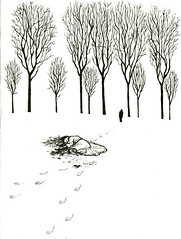
"Murder in the Snow" © 2005 by Kurt Komoda

"Murder in the Snow" © 2005 by Kurt Komoda

A long while back, I had a vivid dream. In this dream, I was basically me, but I was being followed by something. Something that wanted to do me grievous harm.

But in the dream, no one would believe me. I’d describe how I was seeing whatever it was out of the corner of my eye. I’d see it, turn . . . and it wouldn’t be there.

Finally, in the logic of the dream, there was one—or possibly more—person I was trying to convince of my sanity, and I did this by standing under a street light in the middle of a sidewalk, screaming at them that I would show them!

And then, in the dream, I turned my back on my friend(s) and took a step.

Into Death.

It was Death who had been stalking me. Him I’d seen out of the corner of my eye.

It was a horrific dream. Probably the worst nightmare I’ve had in recent memory.

But what I remembered more than just the dream was that when I woke up, I wasn’t screaming. I didn’t yell. I didn’t cry out. I didn’t do any of that.

I whimpered.

One, terrified whimper as I stepped into the chill of Death incarnate.

Now, being a budding writer, my first thought after reassuring myself that I was, in point of fact, not dead was, “This would make a great story.” I jotted down as much of the dream as I could remember.

I didn’t write the story right then, though. No, I wanted the story to be as perfect as possible, and the only way it could remain perfect was for me never to write it.

Logic. It’s a bitch.

I overcame that, eventually. After listening to an episode of the I Should Be Writing podcast (hosted by the multi-talented Mur Lafferty) in which Mur talked about having finally written her ‘inspired by a dream’ story that she had put off writing to make sure she never sullied it by actually trying to write it, I sat down and, in one sitting, wrote about 3000 words of the story. I had several false starts. What POV should I use? Where does the story start? How do I make that whimper scary? I eventually realized that to make it truly horrifying I needed to tell it from another POV than the protagonist. Enter the friend.

I wrote it, workshopped it past the Fountain Pen group, and then set it aside for a while.

Recently, I picked it back up, intent on making it better. So I edited it, making the dialog cleaner, cutting out unnecessary words, etc.

I ran it past the Lawrenceville Science Fiction and Fantasy Writers group (seriously, guys, we need a shorter name), and got a lot of very helpful commentary.

Part of that commentary was that the ending I had written just didn’t work for several people. I’d heard the same thing from the Fountain Pen group as well, but I was convinced I could force it to work.

During the critique, one or two people offered some ideas on how the ending could work better. And I really liked a couple of those.

Over the last couple of weeks, those have been percolating through my head. And last night while driving to the Fountain Pen meeting from work, a gruesome, horrible ending popped into my head—poing!—based on one that someone else had given me during their critique.

I think I finally have something that could work. That I could . . . submit?

All I have to do, now, is write it. Heh.

Now, what does this have to do with the title of this post?

Way back in 1916, a British author and literary critic named Sir Arthur Quiller-Couch published a book called On the Art of Writing. It was a collection of his lectures delivered at the University of Cambridge in 1913-1914. The twelfth and final lecture is called “On Style.” In it, he talks about first what style is not, and gives an example. Then he says the following:

Whenever you feel an impulse to perpetrate a piece of exceptionally fine writing, obey it—whole-heartedly—and delete it before sending your manuscript to press. Murder your darlings. [emphasis his]

We still quote this, today, although it’s often erroneously attributed to other writers. I hear it all the time.

The way it’s usually used is when an author has written a particularly clever turn of phrase or bon mot or whatever, they often will try to keep it during the editing/rewriting process because they like it and not because it serves the story. This ultimately hurts their writing.

So, “Murder your darlings.”

My darling in this story that I’ve preserved through all the edits has been that the protagonist turns and walks into Death with a whimper, and disappears. The guys in the Lawrenceville Science Fiction and Fantasy Writers (Pen-acles? The Write Stuff? Wordniks?) made me finally confront this, and I’m going to murder my darling.

<sharpens axe> Heeeere, darling! Come to papa! He has a present for youuuuu! <insert evil chuckle here>

Originally published at WriteWright. You can comment here or there.

kaasirpent: (WriteWright)
Monday, March 14th, 2011 12:24 pm

"Writing" © 2010 Jonathan Reyes

"Writing" © 2010 Jonathan Reyes

I listen to a number of podcasts1 on a regular basis. One of my absolute favorite podcasts—one that, when I see it download, I immediately listen to it if I’m able—is Writing Excuses. It is hosted by Brandon Sanderson, Howard Tayler, and Dan Wells. Their tagline says it best: “This is Writing Excuses: fifteen minutes long because you’re in a hurry and we’re not that smart.” (But they really are that smart, so it’s, like, irony.)

They occasionally have guests on the show to talk about various topics. The guests in the most recent episode (Season 5, Episode 28: E-Publishing) were Tracy Hickman and David Farland (a.k.a. Dave Wolverton).

All of that link soup is merely a lead-in to tell you the source of the quote I’m about to use from the podcast. It was one that stood out for me the first time I listened, so I restarted the podcast, listened to it again, and this time transcribed what Tracy Hickman said.

Dan (I think) asked Hickman what advice he would give for self-publishers to be successful. His answer was as follows.

Forget about the idea of mass audience. Get rid of the idea of mass audience and deal with individuals. You need to contact people individually, and that’s why things like virtual tours—virtual blog tours—are so important. You need to get in touch with the readership. You need to find the audience. And you find that through the gateway of people’s blogs and personal connection with them. I think that the old time of the old school book tour where you go and fly to some book store in San Francisco and sit there with ten people is done. I think people don’t do that anymore. And book stores—brick and mortar stores—are having enough trouble as it is. What is the case, though, is that you have to concentrate on reaching your audience one on one, and that means going on virtual book tours. That means having a website that is open to people communicating with you, and engaging your audience in a conversation. If you engage your audience—not in a sales conversation, but in an intimate, personal conversation—then they will read your words, and your words will come to life. Your words do not live or breathe until someone reads them and puts life to them and so you need to have the intimate, personal connection with them. So it’s not about mass audience. If there’s one piece of advice I’d give to anybody: it’s about you making a connection with every individual who is going to read your book—at some level—online. [Emphasis added]

And that’s a very good point. I can write and write and write and (I hope) get better and better . . . but until and unless someone gets2 to read my words, I might as well be shouting into a hurricane for all the good it’ll do me.

The “personal connection” thing I think I have. After all, I have this handy-dandy website right here just waiting for people to read it. I have samples of my work up for people to read, and I’m relatively easy to contact (or will be when I get the email for this site working like I want it). So there you go.

I just thought it was important to put those words in bold up there somewhere that I could find them to remind me why I write: because I think I have a story to tell that other people might find interesting.

Oh, and if you’re not already, do listen to the Writing Excuses podcast. If I had to recommend just one podcast for aspiring writers like myself, it would be that one. I’ve learned a lot from Brandon, Dan, and Howard.


  1. Where that number is 81, plus five new evaluations ongoing for “new” ones (to me). Of those 81, I’m “catching up” on 10 of those (i.e., I am downloading new episodes, but listening to them from episode 1, and I’m not up to current, yet). A good many are monthly or on indefinite hiatus at the moment. Of the full 86 (counting the five in evaluation), a whopping 26 deal with writing, reading, books, fiction, language, grammar, and the like. And that doesn’t even count a few that could have gone either way, so it’s probably closer to 30.
  2. “Gets” sounds like it’s a privilege, and some might consider that arrogant. I don’t mean it that way, though. Anyone who reads my blogs or any of my work does so because they chose to do so. I meant it as a stern reminder to myself that no one can choose to do so unless I choose to make them available.

Originally published at WriteWright. You can comment here or there.
kaasirpent: (WriteWright)
Friday, February 25th, 2011 11:56 am

© 2009 by Jef Safi

sεrεndıpıtıng dıffεrAncε catabolısm © 2009 by Jef Safi

I was listening to the Adventures in Sci-Fi Publishing podcast today, and their interview was author Sherrilyn Kenyon, who is wildly successful in the genre of paranormal romance. She had something like 14 best-selling books in the last 18 months and dozens of published novels.

One thing she said resonated with me, because once again, I think it’s something I don’t always do well, and it’s something I need to keep in mind when I’m writing.

She mentioned Plato’s Theory of Forms. Essentially, Plato hypothesized that objects in our reality exist as mere shadows of their perfect, ideal Forms which exist outside of reality. Thus, a table is merely a representation of a Table, which is the purest, most perfect representation of “tableness.”

I’m probably doing a horrible job of explaining it, but it’s really a tangent to her real point. You can read the Wikipedia entry if you want to know more than you ever thought possible about it.

Sherrilyn’s point was that when an author writes, “He picked up a pencil and began to write,” you don’t have to explain that a pencil is seven and a half inches long, wooden, painted yellow, hexagonal in cross-section, with one end sharpened to a point of compressed graphite/clay composite, and the other a soft, rubber nub fastened to the shaft of the pencil by a crimped, aluminum sheath.

Why? Because when a reader reads the word “pencil,” they already have almost a Platonic ‘form’ of it in their mind. They know what a pencil is. Some of them will picture it as I’ve described. Others may picture one that’s red, or one of those big, fat ones we used to use in Kindergarten that weren’t faceted. Still others might picture a carpenter’s pencil or a mechanical pencil. Some might see it as sharpened, while others unsharpened.

And her point was that all we, as writers, have to do is use the least number of words possible to describe something and let the reader’s own experience fill in the rest.

“He picked up a sharpened pencil and began to write.” That’s all we need. We don’t need to mention which hand he wrote with, either (unless it’s important to the story). How many of you who just read that pictured him picking it up in his right hand, and how many his left? I’m betting about 89% of you pictured right and 11% left, because that’s about the distribution of handedness.

You probably also pictured him leaning over and kind of “hunkering down” over the paper. Because that’s what you do when you write. So unless he’s doing something different, don’t bring it up. Let the reader fill in those gaps.

Ms. Kenyon says it amuses her when she reads a review about how descriptive her writing is, because she tries to keep it as bare as possible. Sometimes, she says she has to force herself to add a little detail here and there. It’s kind of like that old trick ‘psychics’ do with cold reading: say as little as possible and let the client fill in the rest. Later, they’ll remember that you told them everything when all you did was suggest, and let them do the hard work.

I get a little wordy from time to time, and not just during NaNoWriMo when every word counts. One of the most common things I see on works of mine after they’ve been critiqued is words and phrases crossed out, often with the notation “not needed” or “too wordy.” I tend to forget that the reader brings a lot to the table. Or the pencil, as it were.

Now I just have to figure out how to get the reader to picture a 12-tentacled, multi-eyed, trilaterally symmetrical, purple and green alien trying to pet a cat.

Made ya!

Originally published at WriteWright. You can comment here or there.

kaasirpent: (WriteWright)
Saturday, February 19th, 2011 08:09 pm

"Fire on the Street" © 2010 by M. V. Jantzen

"Fire on the Street" © 2010 by M. V. Jantzen

I subscribe to Holly Lisle’s email newsletter. Ms. Lisle is the author of what I think can politely be called a cubic assload of books (Is that too technical a term?). She also has a number of courses on how to write—and not just the mechanics of writing (commas, semi-colons, paragraphs, scene structure), but plotting and character development and more. (All of which she sells on her web site.)

She recently sent out a newsletter with advice that really hit home for me and underscored something I’ve been struggling with in my own writing.

She said that instead of building a huge world and then showing it to your readers in every sentence, we should build big . . . but only give the reader as much as they need to know to tell the story we want to tell. With her permission, I’m quoting a little bit of her newsletter here because this is the part that really struck me.

We humans do not live in the world. We live in whatever three square feet of space we’re occupying at the moment, and in order to care about the things going on in the larger world, first the world has to reach into our three square feet of space and touch us.

Think about some of the books you have read and enjoyed that had huge world-building. The Lord of the Rings and The Hobbit spring to mind easily. Tolkien had built an astounding world, rich with mythology, with a history, races of people, languages, and a gigantic, overarching arc of the world itself.

Yet, when he wrote The Hobbit, virtually none of this mountain of world-building was seen. He told a lovely story about a single, unimportant man (well, a Hobbit) who had adventure thrust upon him. The world did, indeed, reach into his space and touch him.

LotR begins the same way, focused on a small band of seemingly unimportant people who have the world impose itself into their lives. It’s only over the larger arc of the story that we learn what’s going on in the outside world. And even though there was a pile of other information Tolkien developed, he left it out of the story, because it would have been too much. That, of course, later became The Silmarillion, which took me years to get through. Probably precisely because it wasn’t about people but Peoples (elves, men, dwarves, orcs, ainur, etc.)

But even though he didn’t tell us all about Eru and the creation of the Ainur and of all the mythology, he knew it, and it informed everything he wrote. And so when the elves sang A Elbereth Gilthoniel, you caught a glimpse of something much deeper.

The Chronicles of Narnia has much the same feel. So much else was woven through these stories than I was even capable of realizing at age thirteen when I first read them and fell in love with them. But virtually none of it was there in those first couple of books. Later, of course, he wove in some of the universe(s) he developed.

Another that jumped quickly to mind was Babylon 5. The TV show. If you’ve never heard of it, go to NetFlix and watch them. All. The series’ creator, Joe Michael Straczynzski (JMS to fans) created a million-year history of the Universe and set the show into a particularly interesting five-year part. Hints of the whole history were dribbled and drabbled to us over the five-year run of the show, until we knew enough to glimpse the depth of his world-building. But he only revealed that which we needed to know to tell the story.

But when I look at the books that are being published, today . . . <sigh> It feels one of two ways, a lot.

Sometimes, it feels as though the writer has gone through all the pain and suffering of developing a world for his characters to inhabit, and he will by God tell you every word of that pile of world-building. Some people call these “map-quest” or “map exploration” stories. You know, ones where the author gives you a map of his world, and you end up exploring every square centimeter of it.

Other times, it feels as though there simply is no more there than the writer has chosen to show you. As though they simply made stuff up as they went along, or added something because it seemed like a good idea at the time. And I suppose if you’re writing a short story or a stand-alone novel, that’s okay. But if you want to sell more in that universe, you should probably have, you know . . . a universe. :)

I know of one author who pretty much did just that. I was reading her books and very much enjoying them, and I wrote her an email to tell her that, and asked how she came up with one of the most intriguing aspects of the world she had built. In her reply, she admitted to me with a winking smily that she had only tossed it in there because it seemed like a neat kind of thing to add, and then later had to go back and come up with a backstory to explain it.

Another couple of authors that do this kind of thing very well (in my humble opinion) are Jim Butcher (The Dresden Files series) and Terry Goodkind (The Sword of Truth series). The worlds they have developed are deep and wide, and full of rich histories and interesting people(s). Goodkind’s first book, Wizard’s First Rule, gave almost nothing of the depth of the world that he had created, focusing only on Richard and the immediate problems presented to him. Likewise, in Butcher’s first book, Storm Front, there are only glimpses of the huge amount of information that he will gradually give us over the course of the next dozen or so books.

This is one of the problem I have. I have done a decent amount of world-building, but I tend to want to sprinkle a bit too much of it into the story. Because I think it’s fascinating, I figure you will, as well. You want to know about the inner workings of time travel, right? Or how the tentacled alien species discovered space travel? Right?

And then I think of The Silmarillion and my ten-year struggle to read it. :)

So that’s what I’m struggling with right now. What to say and what not to say. How much detail to give, and how much to withhold. Ms. Lisle concluded her newsletter thusly, and it will be what I try to keep in mind as I am writing.

All the world you give your reader when you start your story is one moment. One place. And something that matters to pull us in.

Originally published at WriteWright. You can comment here or there.